If you can't see this newsletter properly, please click here |
|
|
|
A no-fluff weekly email for senior photographers who want their business to feel intentional instead of accidental. |
Welcome to this week's edition of SeniorInspire the Newsletter! Let's start this issue with a little thought experiment. Imagine someone offers you a magical photography gadget for $100. No subscriptions, no hidden fees, no YouTube tutorials required. You hand over your $100, and by the end of the year that gadget helps you earn an extra $1,000. Would you buy it? Of course you would. You'd probably buy ten of them.
That's the basic idea behind ROI, or Return on Investment. If a $100 investment generates $1,000 in additional profit, that's a 10x return. Easy math. Easy decision.
Unfortunately, almost nothing in photography is that straightforward.
The lens you want, the education you're considering, the website redesign, the Facebook ads, the new software subscription, the conference ticket... none of them come with a sticker that says, "This purchase will generate exactly $847.32 in additional profit."
That's where things get interesting.
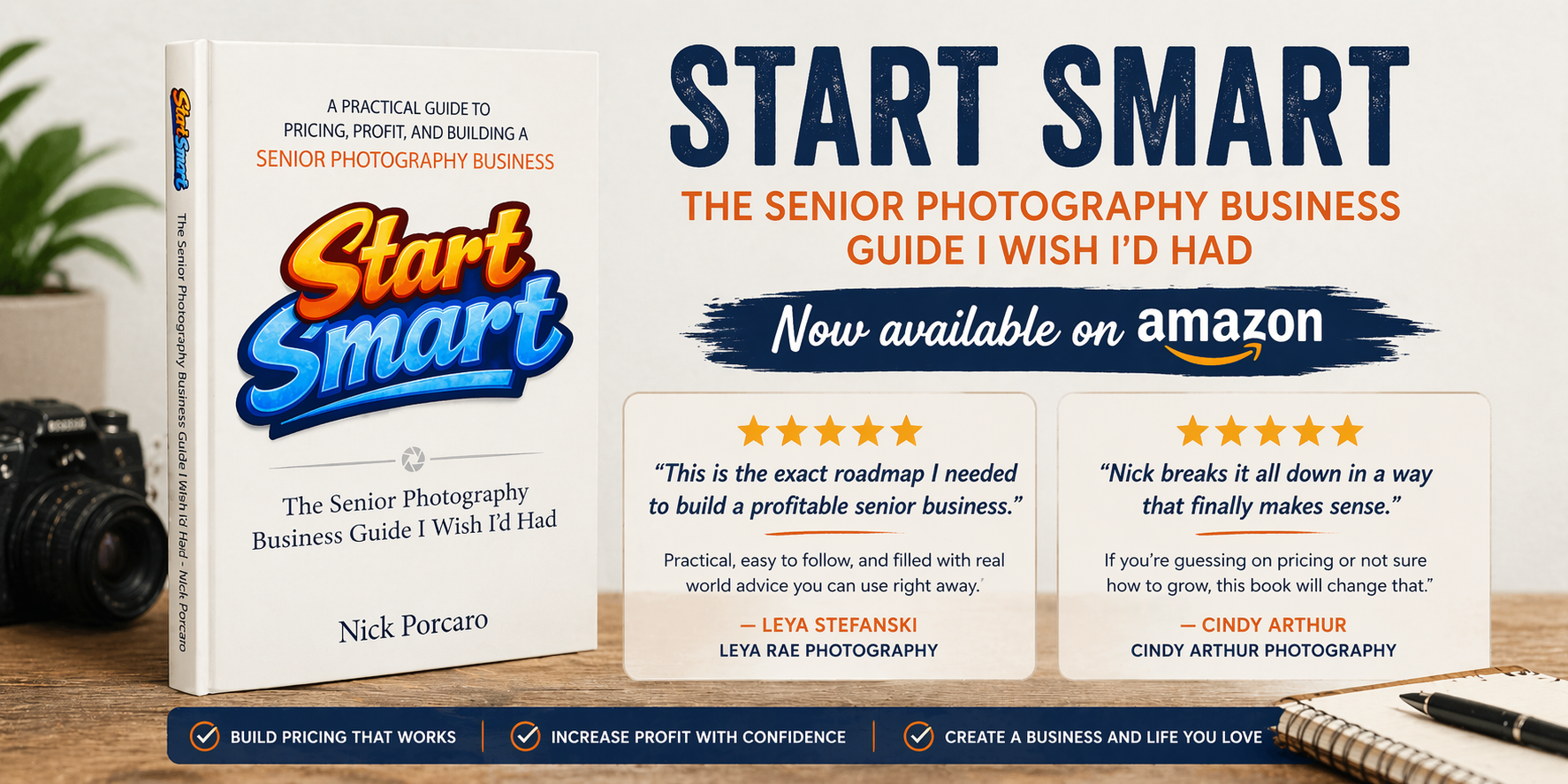
In today's newsletter, we're taking a closer look at the real-world nuance of ROI and how to think about the purchases you make in your business. Some investments pay off directly. Others save time, reduce stress, improve your client experience, or help you grow in ways that are harder to measure but still incredibly valuable. Let's dive in. —Nick PS If you haven't picked up a copy of StartSmart: The Senior Photography Business Guide I Wish I'd Had, it's currently on sale for the 4th of July on Amazon for just $24 (normally $29.99) |
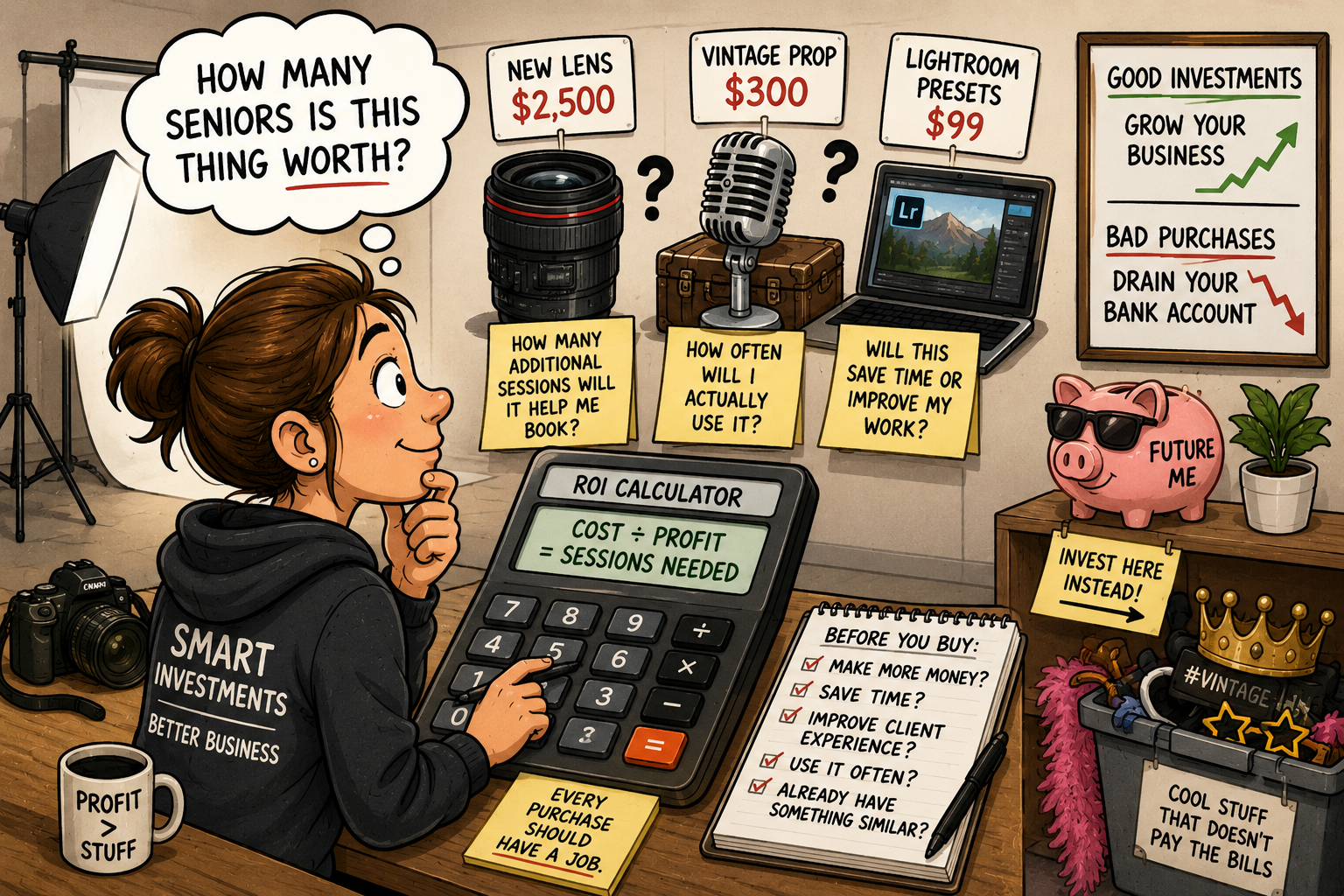
ROI and How to Tell If a Purchase Is Actually Worth It |
Every photographer has done it.
You see a new lens, a cool prop, a Lightroom preset, or some shiny new gadget and suddenly your brain starts building a very convincing business case for why you absolutely need it. Before long you're telling yourself that this isn't really spending money at all.
"This is investing in my business."
Sometimes that's true. Sometimes it's a $99 Lightroom preset pack you'll try for about three days before going back to editing exactly the way you always have.
The challenge isn't deciding whether to spend money. The challenge is figuring out whether a purchase is actually going to help your business. That's where ROI comes in. 💰 What Is ROI? ROI stands for Return on Investment. Now before your eyes glaze over and you start having flashbacks to high school math class, don't worry. This isn't complicated. ROI simply asks one question: If I spend this money, what am I getting back?
Some returns are easy to measure. More bookings, higher sales, and improved efficiency can often be quantified in dollars and cents.
Other returns are harder to measure. Better images, a stronger portfolio, increased creativity, and a better client experience may not have an obvious dollar value attached to them, but they can still improve your business.
The important thing is that every purchase should have a return and every purchase should have a job. 📸 The $2,000 Lens Test Let's say you're considering a new lens that costs $2,000.
And let's say that after covering all of your business expenses, taxes, retirement savings, and personal income needs, your average senior session leaves you with about $200 of True Profit.
That means this lens costs the equivalent of ten sessions worth of money that would otherwise end up in your pocket.
The reason I like looking at purchases this way is because it forces us to think differently about what we're buying. Most photographers immediately start trying to justify the purchase by asking whether the lens will help them book more clients.
But let's be honest. Most of the time your next senior isn't choosing you because you upgraded from one lens to another.
A better question might be this: Am I willing to give up the True Profit from my next ten sessions in order to own this lens?
Maybe the answer is yes. Maybe having that lens will make photography more enjoyable. Maybe it fills a legitimate gap in your gear. Maybe you've wanted it for years and you're finally ready to pull the trigger. Those can all be perfectly valid reasons to buy something. The important thing is understanding the tradeoff you're making.
Most photographers ask: "Can I afford this lens?"
A better question might be: "Am I willing to trade ten sessions worth of True Profit for it?"
That's what ROI is really trying to tell us in this case. Every purchase has a cost. The trick is learning to measure that cost in something more meaningful than dollars. 🎭 The Vintage Microphone Problem Let's talk props. Suppose you spend $200 on a vintage microphone because you have a singer coming in for a session.
Sounds reasonable enough. But then ask yourself how many seniors are actually going to use it.
One this year? One next year? Maybe two the year after that?
Suddenly that $200 prop starts looking a little different. And let's not forget the other question: where are you going to put it?
As photographers, we tend to ignore storage costs because we're usually paying them in square footage rather than dollars. But space is money too. A closet full of props that get used once every couple of years isn't necessarily an asset. Sometimes it's just clutter with good intentions. That said, photography isn't purely a math exercise.
If you genuinely feel like those microphone photos belong in your portfolio, and you're willing to give up $200 of the true profit your business is generating in order to create those images, then go for it.
That's a perfectly valid reason to make the purchase.
The key is understanding what you're buying. You're making an artistic decision, not necessarily a financial one. Those are both acceptable choices, but they're not the same thing. |
🎨 The Lightroom Preset Fantasy
Now let's discuss Lightroom presets. Or Photoshop actions. Or overlays. Or whatever magical editing shortcut is currently being advertised on social media. Every photographer has purchased something while thinking: "This changes everything."
Then six months later they're editing exactly the way they did before. Trust me. I've purchased enough Lightroom presets and Photoshop actions to personally support an entire small industry. The purchases that tend to have the best ROI aren't usually the one-click wonders that promise to transform your work overnight. They're the tools that improve your workflow. Early in my career, I purchased a Photoshop action that worked in conjunction with the Portraiture skin-softening plugin. Among other things it adjusted contrast, reduced redness, and applied skin softening automatically. I used that action as a starting point on virtually every image that came out of my studio for roughly fifteen years. Fifteen years and I think it cost me less than $100. That little action probably saved me hundreds of hours over the course of my career. That's return on investment.
On the other hand, I've purchased plenty of Lightroom presets that looked amazing on the seller's sample images and never once worked the same way on mine. Most of those ended up being a one-time experiment before quietly disappearing into a forgotten folder.
Before buying any editing tool, ask yourself: Will it save me time? Will it improve consistency? Will it improve image quality? And keep in mind that workflow improvements tend to create far more value than miracle solutions.
⚡ Not Everything Needs a Financial Return This is important. Not every purchase needs to survive a CPA-level analysis.
Some purchases inspire creativity. Some make photography more enjoyable. Some simply make you happy to own them. That's okay.
You don't need to justify every purchase with a spreadsheet. But you should understand the difference between an investment, an expense, and a toy. You should also be willing to acknowledge when you're intentionally giving up a portion of your true profit for something that brings you enjoyment, inspiration, or creative satisfaction.
There's absolutely nothing wrong with that. The problems usually start when we call all three investments.
🎯 Six Questions Before You Buy Before purchasing anything for your business, try asking yourself these questions: -
Will this help me make more money?
- Will this save me time?
- Will this improve the client experience?
- Will I use it often?
-
Do I already own something that does essentially the same thing?
- Am I willing to give up part of my true profit for this purchase?
If you can answer yes to several of those questions, you're probably looking at a worthwhile purchase. If not, you may just be experiencing a temporary case of Gear Acquisition Syndrome. And yes, that's a real condition. At least among photographers.
The Bottom Line The goal isn't to stop buying things. The goal is to make intentional decisions about what you buy and why.
Some purchases will make your business more profitable. Some will save you time. Some will simply make photography more enjoyable. All of those can be valid reasons to spend money.
Just don't confuse them with each other.
Because the photographers who build strong businesses aren't necessarily the ones who spend the least. They're the ones who understand exactly what they're getting in return. |
|
|
|
Phoenix Photography Masterclass with Max Lee: Only 3 Spots Left |
After countless requests, Max Lee is finally hosting another workshop.
This July 28th, join Max for an exclusive 2-day photography masterclass in Phoenix, Arizona. Designed for photographers who want to create, not just listen. This intensive experience focuses on hands-on shooting in the desert, urban environments, and studio settings. You'll learn how to master natural light, reflectors, off-camera flash, harsh midday sun, and dramatic sunrise conditions while building an incredible portfolio along the way.
Only 3 spots remain. A 75-mile radius restriction applies around San Antonio, TX and Eau Claire, WI.
Interested? Contact Max directly for details and availability.
|
Each week, I’m spotlighting one standout image from the thousands of senior photos we’ve featured over the years — in the magazine, on Instagram, and beyond. Whether it’s the light, the vibe, or just that unexplainable something, these are the images that made me stop and say, “Wow.” |
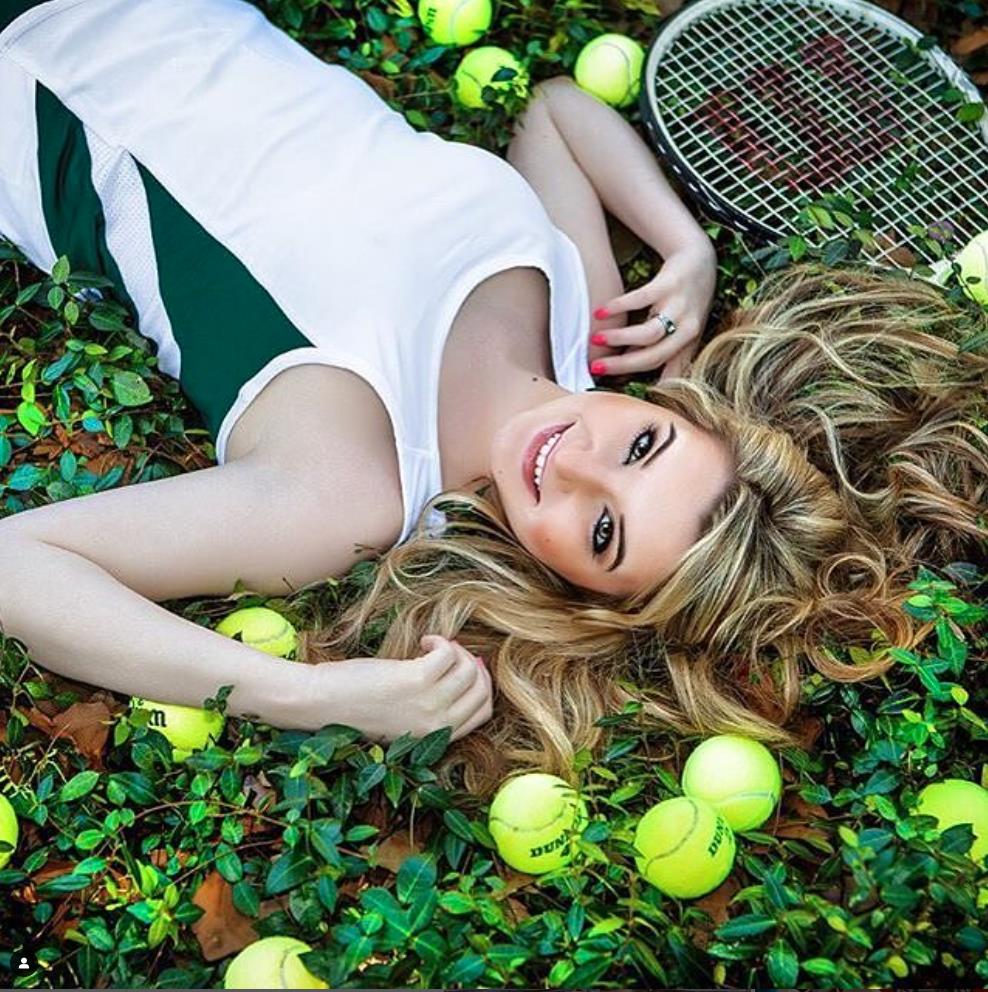
This week’s Why I Love This Image comes from Kirk Voclain of Houma, Louisiana. Around the senior photography world, Kirk hardly needs an introduction. He's a legendary photographer, educator, and these days, an accomplished spy novelist as well. This image was featured on the SeniorInspire Instagram page several years ago, and it remains a perfect example of what happens when creativity, styling, and execution all come together.
The first thing that struck me about this image is the pose.
Laying a senior flat on the ground isn't exactly a revolutionary concept, but Kirk elevates it by surrounding her with visual elements that transform the photograph into something much more memorable. The overhead perspective creates an intimate feeling, almost like we're looking down into a carefully constructed scene rather than a traditional portrait. Then there are the colors.
The harmony throughout this image is fantastic. The rich greens of the foliage tie beautifully into the green accents of the senior's tennis uniform, creating a cohesive palette that feels natural and intentional. But my favorite color relationship is between all those greens and the senior's eyes. They absolutely sparkle in this photograph. The surrounding colors act almost like a frame, directing your attention straight to her face.
Speaking of the scene, let's talk about the tennis balls.
I love the seemingly random arrangement scattered throughout the frame. Of course, photographers know there is nothing random about a photograph this well executed. The tennis balls provide pops of bright yellow-green that keep your eye moving throughout the image while instantly communicating the senior's sport. It's a simple concept, but it works beautifully. The tennis racket is another nice touch. Rather than dominating the composition, it quietly sits in the upper corner of the frame, adding context without stealing attention from the senior. It completes the story without becoming the story. The senior deserves plenty of credit here as well. Her expression is warm, confident, and approachable. She looks relaxed and completely comfortable in front of the camera. Combined with flawless hair and makeup, she becomes the undeniable focal point of the image. And let's not overlook that hair.
The way it fans out across the greenery creates wonderful texture and movement. It softens the composition and provides a beautiful contrast to the round shapes of the tennis balls scattered throughout the frame. It's one of those details that helps make the image feel polished and complete. What I appreciate most about this photograph is that it feels creative without trying too hard. Every element supports the concept. The sport, the colors, the props, the pose, and the expression all work together to tell a clear story. That's not easy to do, but Kirk makes it look effortless. And when a photographer can make something this thoughtfully constructed feel completely natural, that's when you know you're looking at great work. So yeah, that’s why I love this image. |
This Week’s Question:
I spend hours looking at poses on Instagram, Pinterest and in the SeniorInspire Facebook Group, but the minute I get to a session my mind goes completely blank. How do I stop freezing up and actually remember what I've learned? |
First, let me reassure you that your brain is not broken. In fact, I think just about every photographer goes through this stage. At home, sitting on the couch, you can scroll through Instagram for an hour and convince yourself you've got posing figured out. Then you arrive at a session, a senior and her mom are standing there looking at you expectantly, and suddenly your brain decides now would be a good time to forget every pose you've ever seen. It's a rite of passage.
The good news is that this gets dramatically better with experience.
The first thing I'd suggest is to stop trying to remember fifty poses and focus on five. Most photographers make posing harder than it needs to be. The reality is that many great senior sessions start with the same handful of basic poses and then evolve from there. Start with the easy ones... - Over the shoulder.
- Hands on hips.
-
Leaning against something.
- Walking toward the camera.
- Sitting on a step.
Those aren't exciting Pinterest poses, but they're reliable starting points. Once you get your senior into one of those positions, you can begin making small adjustments and creating variations.
The secret isn't knowing hundreds of poses. The secret is knowing how to build from a few good ones.
🧱 Use What's Already There One thing newer photographers often miss is that locations are full of posing ideas. Look for elements you can use. - A brick wall.
- A wooden staircase.
- A fence.
- A bench.
- A doorway.
-
A patch of tall grass.
The location itself often tells you what to do next. A staircase practically begs someone to sit on it. A wall suggests leaning. A fence suggests resting a hand or elbow. Instead of asking, "What pose should I do?" start asking, "What can I do with this element?" You'll often find the answer much faster. 🚗 Scout New Locations Ahead of Time
If you're shooting somewhere new, try to visit beforehand. Even a quick ten-minute walk-through can make a huge difference.
You'll notice where the good light is, where the backgrounds are clean, and what features might make interesting posing opportunities. The more decisions you make before the session starts, the fewer you'll have to make while a senior is standing in front of you waiting for direction. Confidence often comes from preparation. |
📱 Don't Be Afraid to Use References This might surprise you, but most photographers aren't carrying every pose they've ever learned around in their heads. If you need a few screenshots on your phone, bring them. Just don't spend five minutes studying them in front of your client.
Take a quick look, remind yourself of the concept, and move on. Better yet, review them while your senior is changing outfits. A cheat sheet is preparation, not cheating. 😌 Relax, They're Nervous Too
This is probably the most important point. You think you're nervous? The senior is usually more nervous.
Most teenagers aren't used to being professionally photographed. They don't know what to do with their hands. They don't know if they're standing correctly. They're wondering if they look awkward.
And honestly? The first few photos are usually a little stiff anyway. That's normal. The beginning of a session isn't where the magic happens. It's where everyone gets comfortable. Give yourself permission to ease into it. 🎯 Trust the Process
You've already done the work. Those hours you spent studying Pinterest and Instagram weren't wasted. Your brain is learning patterns even when it doesn't feel like it.
The first few sessions can feel like you're making it up as you go. Then somewhere along the way, you'll find yourself directing a senior into a pose without even thinking about it. You'll notice a staircase and immediately know three things you want to try. You'll spot a wall and instinctively start building ideas around it. That's when you realize the studying actually worked. Final Thought The goal isn't to walk into a session with 500 poses memorized. The goal is to walk into a session with enough confidence to start. Start with a simple pose. Use the location. Build from there. Trust what you've learned.
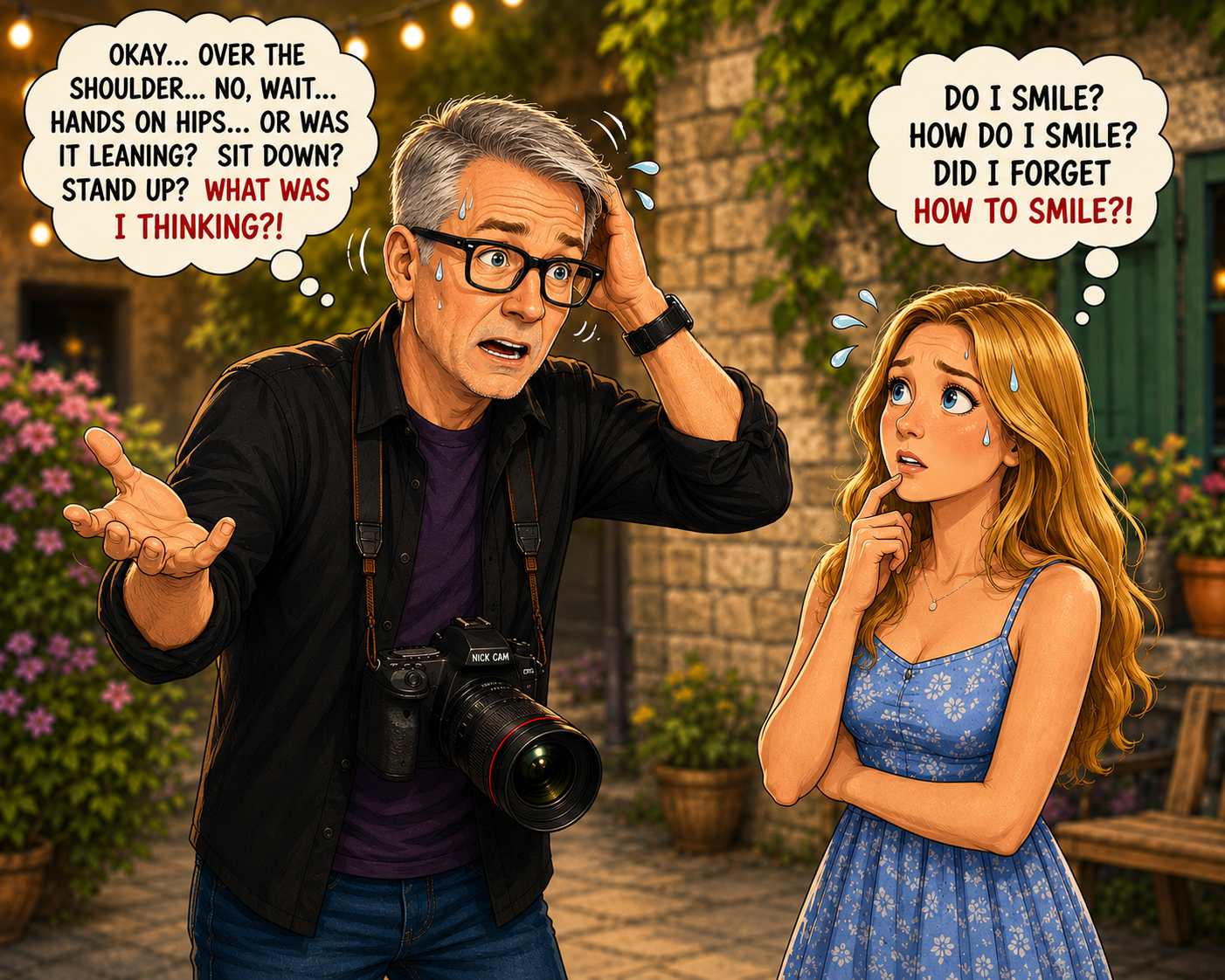
And remember, while you're standing there worried you've forgotten every pose you've ever seen, your senior is probably standing there worried she forgot how to smile. You're both figuring it out together.
|
Have a burning question you want answered in a future column? Head over to www.seniorinspire.com/asknick. I’ll be there manning the phones and waiting for your questions... |
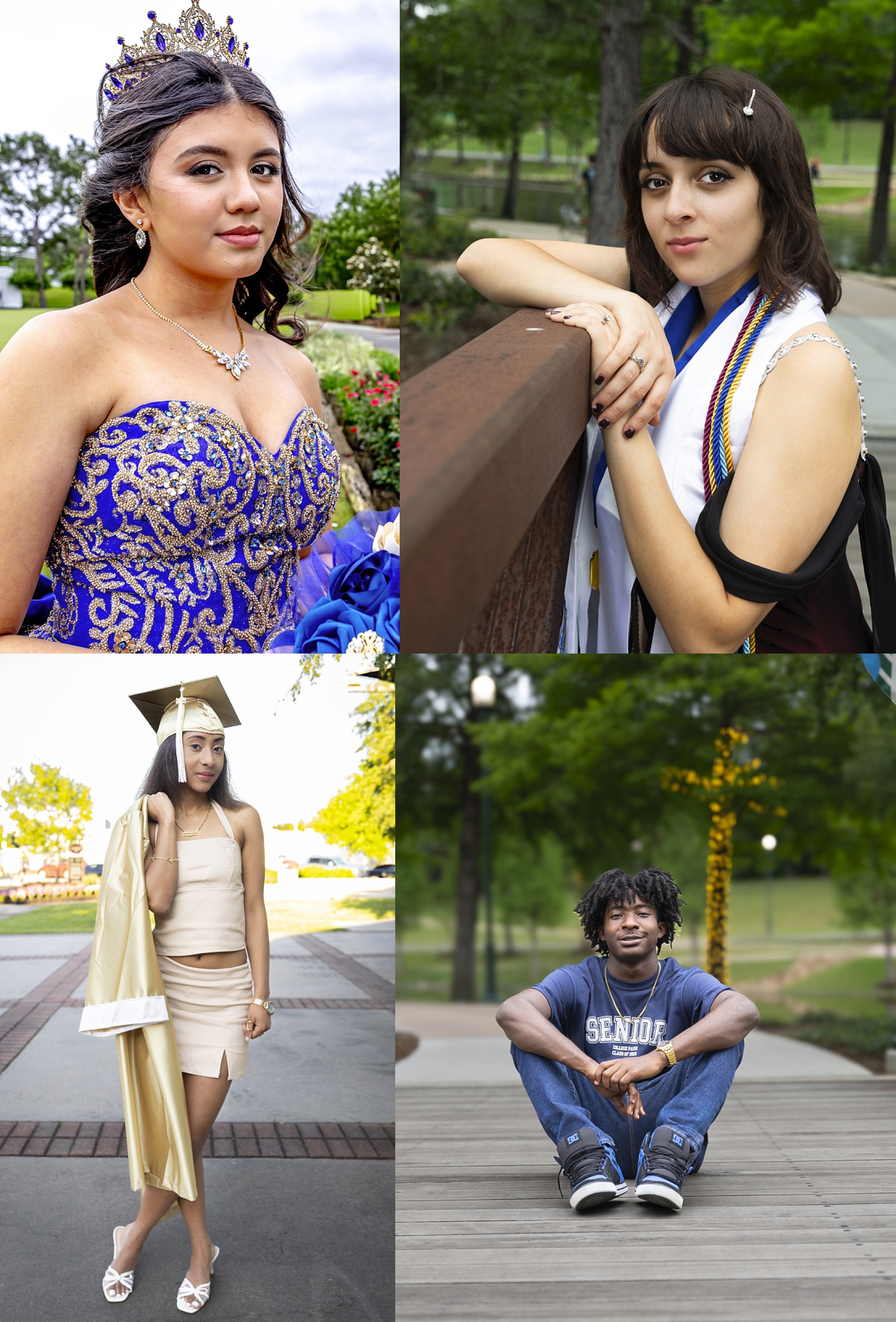
This week’s Photographer of the Week is Jodie Lane of The Woodlands, Texas.
Jodie is a photographer whose work I’m not terribly familiar with, which is one of the things I love about this feature. It gives me a chance to discover talented photographers who may not have been on my radar before. And after spending some time with Jodie’s images, I can safely say I’m looking forward to seeing a lot more of her work in the future. There’s a thoughtful quality to what she creates that immediately caught my attention, and I think you’ll enjoy getting to know her work as much as I did. Take a look at the images we’re sharing this week and learn a little more about Jodie in the bio below. |
Hi there! I'm Jodie, and I photograph people, stories, and adventures throughout the North Houston area, as well as Austin and parts of Louisiana. If I had to describe my style in one phrase, it would probably be "beautifully all over the place!" I'm endlessly inspired by color, texture, movement, weathered old barns, wide-open fields, water, art, but mostly stories. My background is in dance and theatre, and I always enjoyed capturing great moments portrayed on the stage. Little did I know that one day my passion for photography would expand beyond theatre. It was 2020 when I decided to take this passion seriously. The world we had all known was taking on a deeper need for connection, encouragement, acceptance, and hope. I knew there were stories to be told; stories of triumph, hardships, tenacity, and joy. I wanted to uncover those stories in hopes of reminding people of the value and relevancy they still had.
Little did I know how profound that would be a few years later. As I began to learn more about the art of photography, I loved what I could convey through the lens of my camera, all the while allowing people to simply talk. And that's when the magic happened... they lingered long past the ‘session’ and had a new lightness in their voice. I like to think they left with newfound hope. Hope in this world, hope in their circumstances, and certainly knowing they are valued.
My photography style reflects timeless warmth, inviting beauty, and a reflection of my client’s personality. I aim to create images that reflect the value of each person. Through my photography, I hope to bring light and positivity to those I photograph.
One of the most meaningful projects I've been involved in was with a local nonprofit that provides assistance for homeless teens. They had to meet certain criteria and be recommended by school counselors, but these teens had been dealt hardships that are astounding. Yet against all odds, they found the quiet resilience and fortitude to take one day at a time, thus changing the trajectory of their young lives.
The nonprofit hired me to take their senior portraits. Their cap and gowns were provided for them, they were provided transportation to an agreed-upon location, and my services were provided at no charge. What an experience this was, and I was deeply moved hearing their stories, but mostly seeing their quiet confidence. I think photography has a unique way of capturing "silent stories," and I applaud those in the industry who authentically continue to lead the way. I don't think we realize how powerful our images can be to the subjects we capture. I hope my work will always allow people to see their own worth. |
Hey! Want to be considered for our Photographer of the Week feature? Head to www.seniorinspire.com/potw and submit your work. Remember, you don’t have to be the loudest. You don’t have to have the biggest following. You just have to be doing good work and willing to share it. |
|
|
|
Thanks for reading all the way to the end. I appreciate you spending part of your week with me.
This week we talked about ROI and the strange phenomenon where photographers can remember the lyrics to a song they haven't heard since high school but somehow forget every pose they've ever studied the moment a senior steps in front of the camera.
If that's you, don't worry. You're in good company. A lot of photographers spend hours studying poses, then start every session with, "Okay, let's just have you stand there..." and hope inspiration arrives before panic does.
And when it comes to ROI, remember that every purchase is an investment until the credit card bill arrives. Then it's just math.
Keep learning, keep improving, and keep showing up. The photographers who succeed aren't always the ones with the best memory. They're usually the ones who keep going after they've forgotten what pose comes next.
See you next week. 📸 Nick
SeniorInspire |
One last thing before we go... If you made it this far and have any opinions or ideas I'd love to hear it. Good, bad, whatever. Just hit reply or send me an email and let me know what you think. I love the feedback! |
Like what your read? Forward to a friend.
Not subscribed? Go HERE to get on the list. |
|
|
|
|